About College Corps at UC San Diego
UC San Diego is proud to be among 45 statewide campuses selected for the #CaliforniansForAll College Corps program. Students accepted into College Corps at UC San Diego engage in community-serving opportunities that focus on K-12 education, climate action, food insecurity, and public health while also receiving financial compensation and other benefits.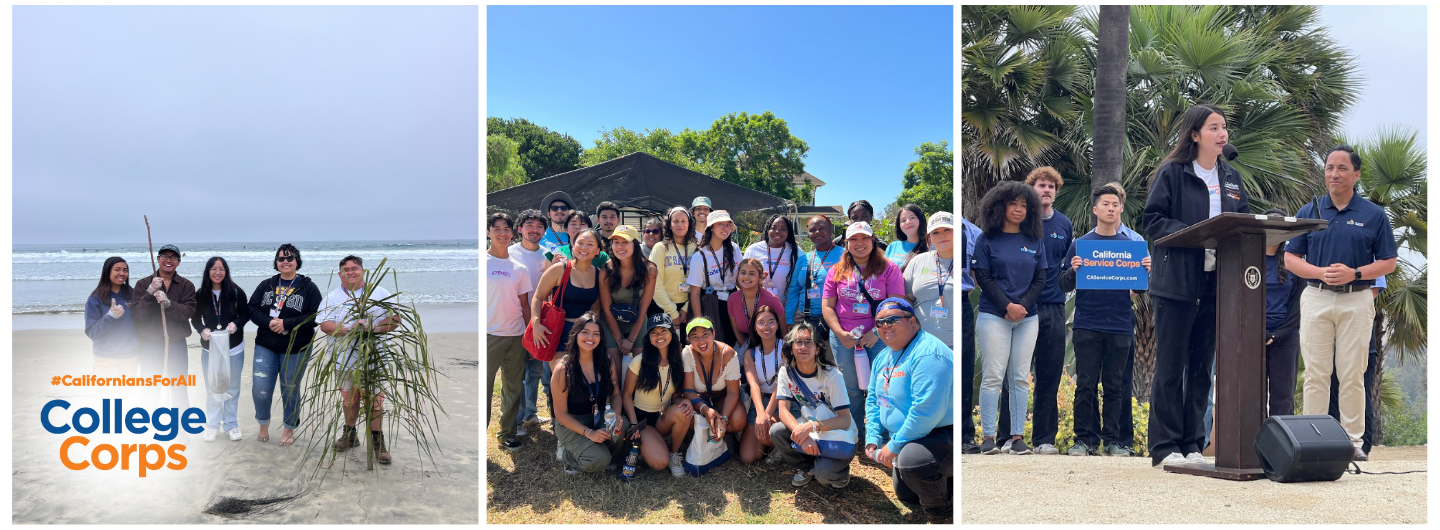
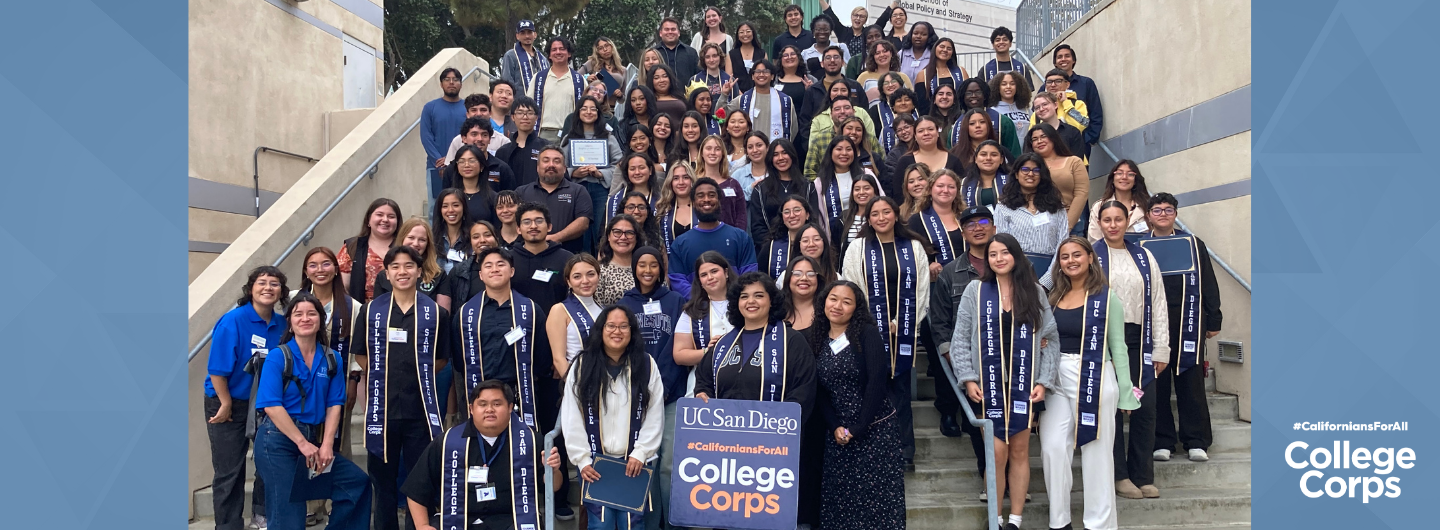


Goals
#CaliforniansForAll College Corps is the largest state-level investment in a college service program in California history.
College Corps at UC San Diego aims to:
- Create a generation of civic-minded leaders with the ability to bridge community divides and address social problems;
- Help low-income students graduate college on time and with less debt;
- Address societal challenges;
- Connect students to community partners via direct service; and
- Help build more equitable communities across California.
Benefits
What You'll Get
Each student serving as a College Corps Fellow for the academic year receives:
- An opportunity to create a more just, inclusive, and sustainable world by supporting K-12 education, reducing food insecurity, and addressing climate change and public health in our community
- Real-world professional experience and resume-building skills
- Access to training, networking, and professional development opportunities
- Up to a $7,000 living stipend and a $3,000 education award upon completion of 450 fellowship hours to help pay for college
- A sense of pride and accomplishment in working toward a common purpose alongside leaders from across the state
Eligibility
College Corps at UC San Diego Eligibility
Students interested in applying to College Corps at UC San Diego should meet the following criteria:
- Be at least 18 years old by the start of the program
- Be a full-time, enrolled UC San Diego undergraduate student
- Maintain a cumulative UC San Diego GPA of 2.5 or above
- Commit to the program for the full 450 hours during the academic year (no early graduation or study abroad during fall, winter, or spring quarter)
In addition, eligible fellows are required to:
- Complete a National Service Criminal History Check and Live Scan, upon selection
The College Corps fellowship is designed for low- to moderate-income students. Therefore, each student selected to join the fellowship should meet at least one of the following criteria:
- Qualifies for a federal Pell grant, OR
- Qualifies for a State Cal Grant, OR
- Qualifies for a Middle Class Scholarship, OR
- Needs to work part time and/or borrow student loans to meet their educational costs, OR
- Is an AB-540 California Dream Act student:
- Must have a completed and submitted a California Dream Act Application (CADAA) for the academic year
- Must be an active recipient of a Cal Grant A or B Award for the academic year
- Must submit a CA DSIG Application to become eligible for Education Award
Service Areas
Through College Corps at UC San Diego, fellows will serve in one of four areas throughout greater San Diego during the academic year:
- Assisting local K-12 schools and education organizations;
- Participating in climate action research and community engagement;
- Addressing food insecurity in our region; or
- Addressing public health needs in our region.
A Day in the Life
Day-to-day activities depend on each fellow's placement.
- Fellows focused on K-12 education might: work with a teacher to plan and set up lessons, lead classroom or extracurricular activities, tutor students 1:1, or work with teachers leading after school programming.
- Fellows focused on climate action might: remove invasive species, support habitat restoration or conservation, develop communications or educational content about environmental and climate issues.
- Fellows focused on food insecurity might: lead food recovery efforts, host food distributions, prepare meals, or maintain a garden.
- Fellows focused on public health might: interview community members about housing insecurity, conduct outreach to community members about nutrition, or develop communications or educational content about local health issues.
Questions? Please contact:
In accordance with applicable Federal and State law and University policy, the University of California does not discriminate, or grant preferences, on the basis of race, color, national origin, religion, sex, disability, and/or other protected categories.
More information about Proposition 209 can be found here.
More information about the University of California Anti-Discrimination Policy can be found here